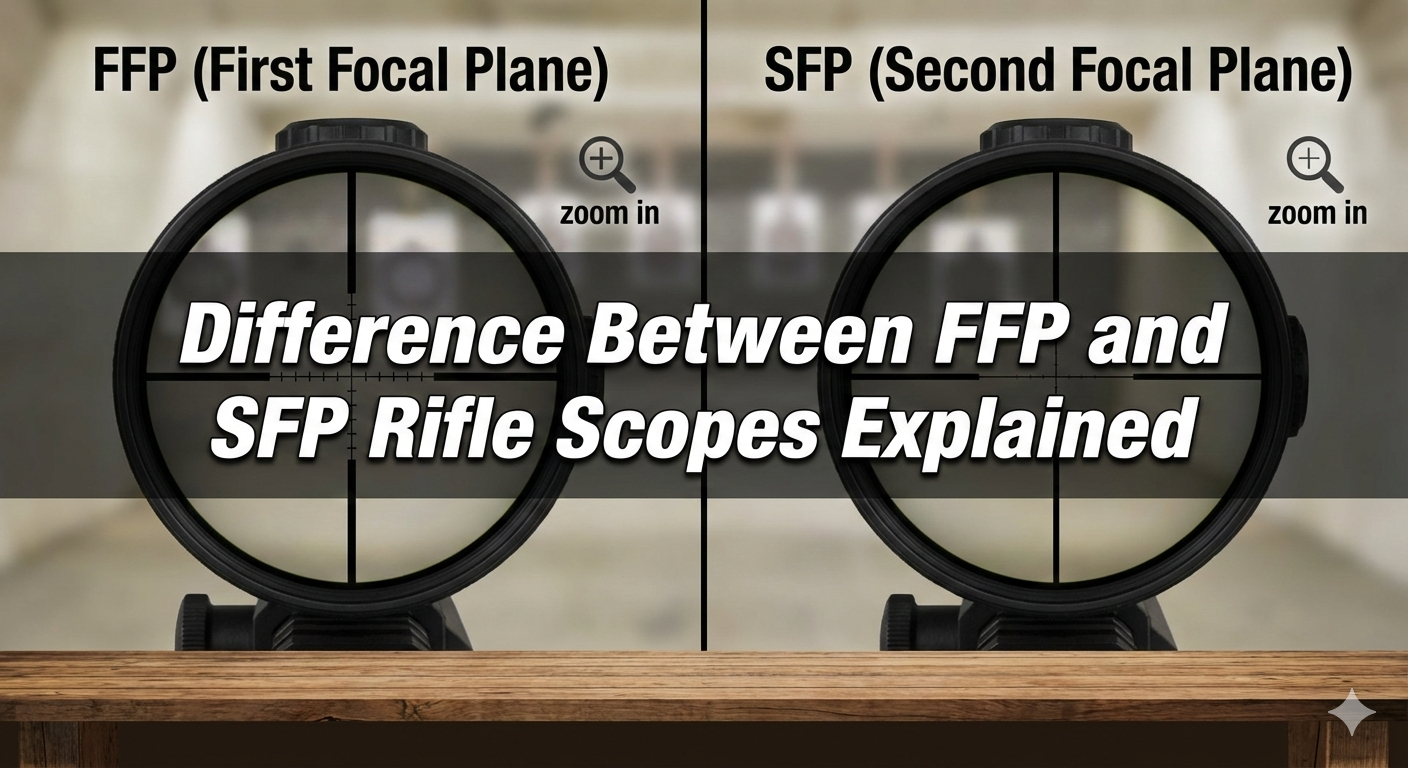
Choosing the right rifle scope is one of the most important decisions a shooter can make, whether for hunting, long-range precision shooting, or tactical applications. Among the many technical terms used in optics, FFP (First Focal Plane) and SFP (Second Focal Plane) are often the most confusing for beginners and even intermediate shooters. Understanding the difference between these two scope types is critical because it directly affects accuracy, ranging, holdovers, and real-world performance.
This guide explains the difference between FFP and SFP rifle scopes in detail, how each works, their advantages and disadvantages, and which one is best for your shooting style.
Table of Contents
To understand FFP and SFP scopes, you first need to understand what a focal plane is. Inside every rifle scope, the reticle (crosshair) is positioned on a focal plane relative to the magnification lenses. The position of the reticle determines how it behaves when you zoom in or out.
There are two possible positions for the reticle:
This single design choice creates all the functional differences between FFP and SFP scopes.
In a First Focal Plane (FFP) scope, the reticle is placed before the magnification lenses. This means the reticle changes size as you change magnification. When you zoom in, the reticle appears larger; when you zoom out, it appears smaller.
The key advantage of this design is that the reticle stays proportional to the target at all magnification levels. As a result, the reticle’s subtensions used for ranging, holdover, and windage remain accurate no matter what magnification you are using.
This makes FFP scopes especially popular among long-range shooters, tactical professionals, and competition shooters.
The biggest advantage of an FFP scope is consistent accuracy at all magnifications. If your reticle is calibrated in MILs or MOA, those measurements are always correct, whether you are shooting at 4x or 20x.
This consistency allows shooters to:
FFP scopes are also ideal for situations where magnification changes frequently, such as PRS competitions or tactical operations.
Despite their advantages, FFP scopes are not perfect. One common issue is reticle visibility at low magnification. Because the reticle shrinks as you zoom out, it can become very thin and hard to see in low light or against dark backgrounds.
FFP scopes are also typically more expensive. The engineering required to maintain optical clarity while scaling the reticle adds cost, making FFP scopes less budget-friendly.
For hunters who primarily shoot at fixed magnification and known distances, these disadvantages may outweigh the benefits.
In a Second Focal Plane (SFP) scope, the reticle is placed after the magnification lenses. This means the reticle stays the same size, regardless of magnification.
While the target image zooms in and out, the reticle remains constant, making it easy to see and use at all times. However, the reticle’s subtensions are only accurate at one specific magnification, usually marked by the manufacturer.
SFP scopes are the most common type found on hunting and general-purpose rifles.
The biggest advantage of SFP scopes is reticle visibility. Since the reticle never changes size, it remains bold, clear, and easy to use, especially at low magnification or in low-light conditions.
SFP scopes are also:
For most hunters shooting within typical distances, an SFP scope provides all the performance they need.
The main limitation of SFP scopes is that reticle measurements are only accurate at one magnification. If you try to range or use holdover marks at a different zoom level, your calculations will be wrong unless you manually compensate.
This can slow down shooting and introduce errors, especially in long-range or fast-paced situations. SFP scopes are less suited for precision shooting where frequent magnification changes are required.
The most important difference between FFP and SFP scopes is reticle scaling behavior. FFP reticles scale with magnification, while SFP reticles remain fixed in size.
FFP scopes prioritize precision and flexibility, making them ideal for advanced shooters who rely on reticle-based calculations. SFP scopes prioritize simplicity, clarity, and affordability, making them ideal for hunters and recreational shooters.
Another critical difference is cost. FFP scopes generally sit in higher price brackets, while SFP scopes offer excellent value for everyday use.
Choosing between FFP and SFP depends on how you shoot, not which one is “better.”
An FFP scope is the right choice if you:
An SFP scope is the better choice if you:
For many shooters, an SFP scope is more than sufficient, while advanced or professional shooters often benefit from FFP precision.
Understanding the difference between FFP and SFP rifle scopes allows you to make a confident, informed decision based on your shooting needs. FFP scopes excel in precision and versatility, while SFP scopes shine in simplicity and visibility.
There is no universal “best” choice only the best scope for your specific application. By matching your scope type to your shooting style, you’ll improve accuracy, confidence, and overall performance in the field or on the range.
Selecting the best scope magnification for shooting at 300 yards is a decision that directly…
Traveling with a firearm whether for hunting, competitive shooting, professional training, or lawful personal protection…
Preparing for a successful day at the shooting range involves much more than simply bringing…
Selecting the right tactical scope for hunting is one of the most important decisions a…
Hunting has always been deeply connected to nature, patience, and self-reliance. For generations, success in…
Choosing the right rifle scope is one of the most important decisions a shooter or…
This website uses cookies.
