Do You Need a Tactical Scope for Hunting?

Choosing the right rifle scope is one of the most important decisions a hunter can make. With the growing popularity of long-range shooting and military-inspired optics, many hunters now ask an important question: Do you really need a tactical scope for hunting, or is it overkill?
Tactical scopes are packed with advanced features like exposed turrets, complex reticles, and first focal plane designs. While these features are highly effective in precision shooting environments, they may not always be necessary or even practical for hunting. This article breaks down what a tactical scope is, how it differs from traditional hunting scopes, and whether it truly adds value in real-world hunting scenarios.
Table of Contents
- What Is a Tactical Scope?
- Common Features of Tactical Scopes
- What Hunters Actually Need From a Scope
- When a Tactical Scope Makes Sense for Hunting
- When a Tactical Scope Is Not Necessary
- Tactical Scope vs Hunting Scope: Key Differences
- Practical Questions to Ask Before Choosing
- Final Verdict: Do You Need a Tactical Scope for Hunting?
What Is a Tactical Scope?
A tactical scope is designed primarily for precision shooting, military, law enforcement, and long-range target applications. These scopes emphasize accuracy, repeatability, and precise adjustments rather than simplicity.
Key characteristics of tactical scopes include exposed elevation and windage turrets, detailed reticles with holdover markings, higher magnification ranges, and rugged construction. Many tactical scopes are built to handle constant dialing of adjustments and harsh environments without losing zero.
In contrast, traditional hunting scopes are designed for quick target acquisition, lightweight handling, and simplicity, focusing more on ethical shot placement than extreme precision.
Common Features of Tactical Scopes
Exposed Turrets for Precise Adjustments
Tactical scopes use large, exposed turrets that allow shooters to dial elevation and windage adjustments accurately. Each click corresponds to a precise movement, often measured in MOA or MIL.
While this is excellent for long-range shooting, most hunters rarely dial adjustments in the field. Hunting shots are often taken quickly, and dialing turrets can slow down the process.
Advanced Reticles
Tactical reticles include hash marks, grids, or “Christmas tree” designs that help estimate range, wind drift, and bullet drop. These reticles are invaluable for long-distance precision shooting.
However, in low-light hunting situations such as dawn or dusk complex reticles can appear cluttered and make it harder to place a clean shot on game.
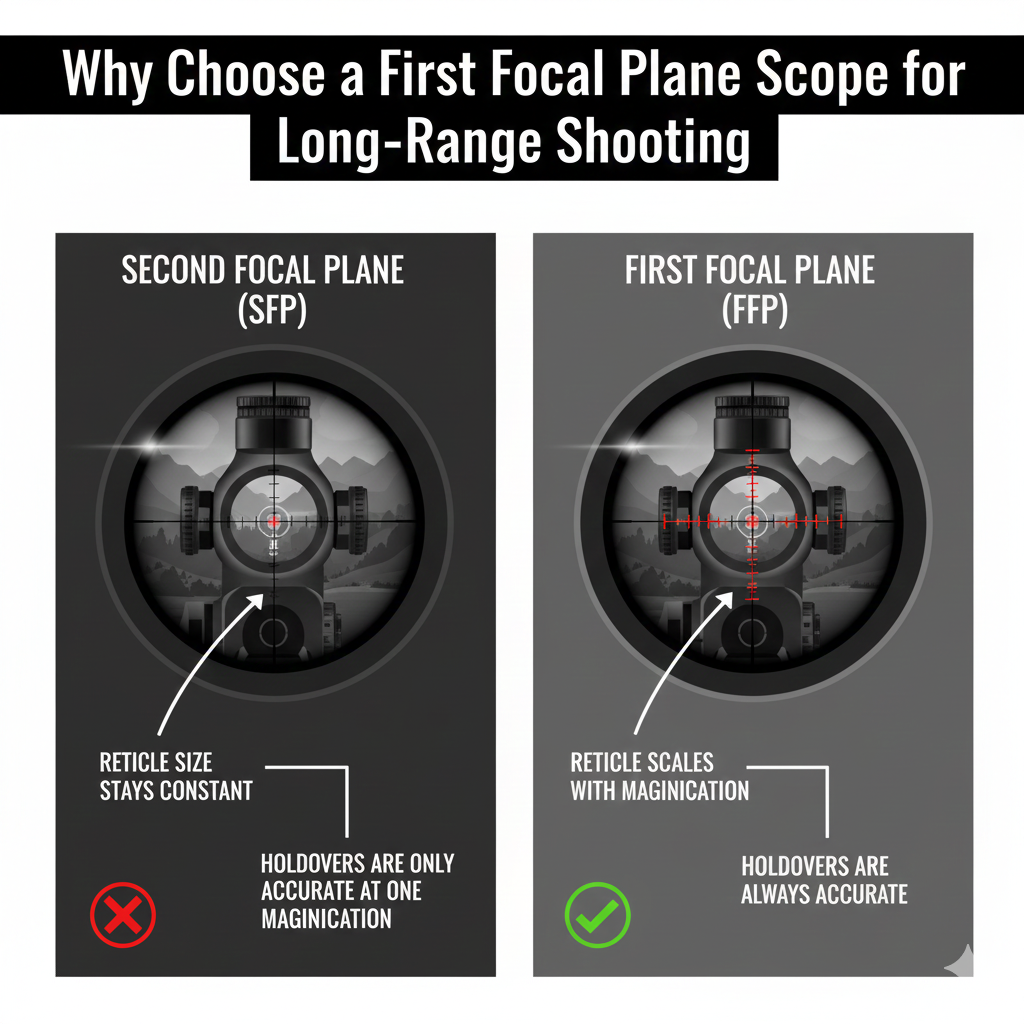
First Focal Plane (FFP) Optics
Many tactical scopes use a first focal plane reticle, which changes size as magnification increases or decreases. This ensures that reticle measurements remain accurate at any zoom level.
For hunters, this feature can be useful at longer ranges, but it also means the reticle can become very thin at low magnification, reducing visibility in poor lighting conditions.
Higher Magnification Ranges
Tactical scopes often start at 5x or higher and extend beyond 20x magnification. While this is ideal for extreme long-range shooting, most hunting scenarios occur inside 300 yards, where lower magnification provides better field of view and faster target acquisition.
What Hunters Actually Need From a Scope
Before deciding whether a tactical scope is right for hunting, it’s important to understand what matters most in the field.
Hunters typically need a scope that is lightweight, reliable, easy to use, and effective in low-light conditions. Shots may need to be taken quickly, sometimes from awkward positions, and often without time to adjust turrets or analyze complex reticles.
In many cases, simplicity beats sophistication.
When a Tactical Scope Makes Sense for Hunting
Although tactical scopes are not essential for most hunters, there are situations where they can be beneficial.
Long-Range Hunting
If you regularly hunt in wide-open terrain such as mountains, plains, or deserts, where shots exceed 400 yards, a tactical scope can provide a real advantage. The ability to dial precise elevation adjustments and compensate for wind can increase shot accuracy at extended distances.
Precision-Focused Hunters
Some hunters enjoy a technical, data-driven approach to shooting. If you practice long-range shooting, know your ballistic data, and are comfortable using turret adjustments and advanced reticles, a tactical scope may suit your hunting style.
Dual-Purpose Rifles
If your rifle is used for both hunting and long-range target shooting, a tactical scope can serve both purposes, eliminating the need to switch optics.
When a Tactical Scope Is Not Necessary
For many hunters, a tactical scope may add more complexity than value.
Short to Medium Range Hunting
In dense woods or brush, shots are often under 200 yards. In these situations, a simple 2-7x or 3-9x hunting scope is faster, lighter, and easier to use.
Weight Considerations
Tactical scopes are usually heavier due to their reinforced construction and larger components. Carrying extra weight over long distances can lead to fatigue, especially during backcountry hunts.
Low-Light Performance
Traditional hunting scopes often have simpler reticles and superior low-light clarity. In critical moments at dawn or dusk, a clean reticle and bright image can be more valuable than advanced tactical features.
Cost vs. Benefit
Tactical scopes are generally more expensive. If you’re not using their advanced features regularly, you may be paying for capabilities you don’t need.
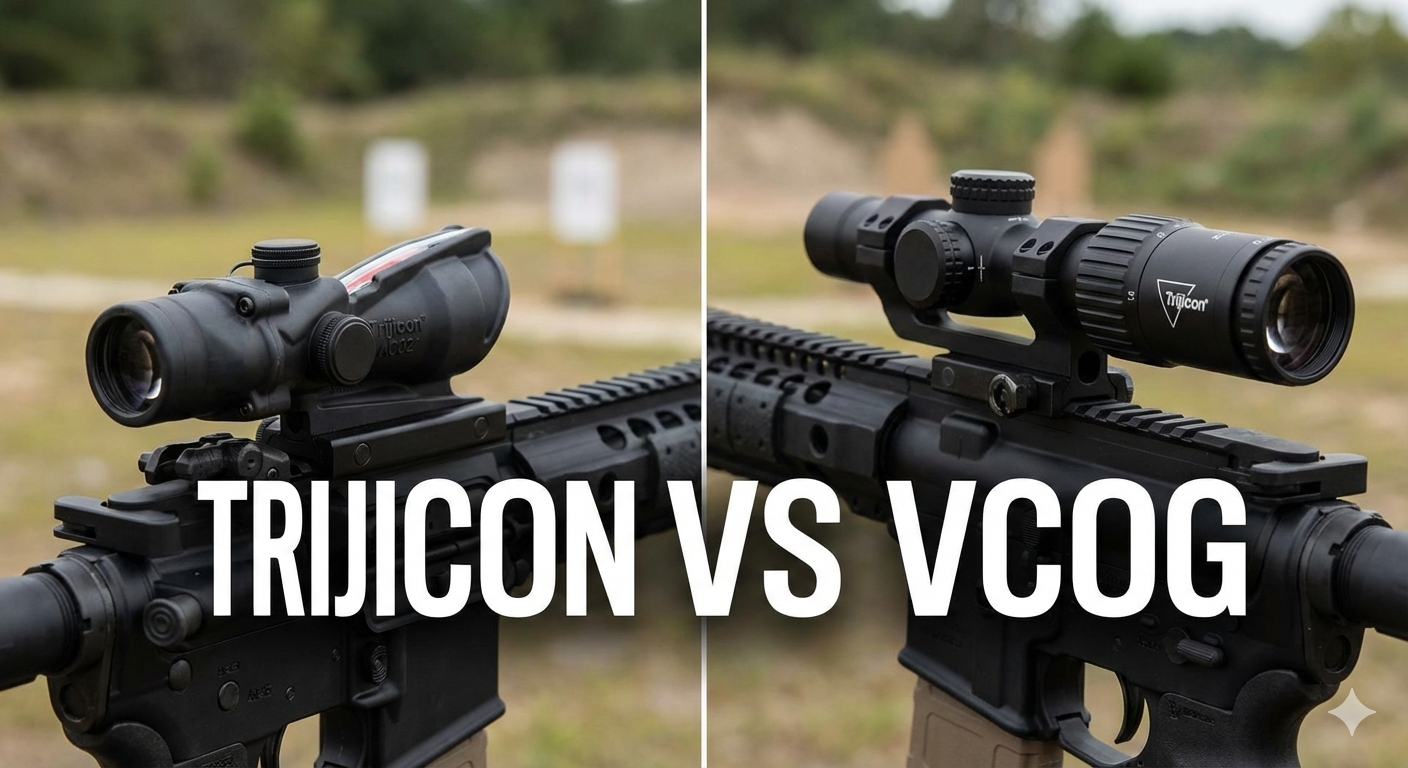
Tactical Scope vs Hunting Scope: Key Differences
The biggest difference between tactical and hunting scopes lies in their intended use. Tactical scopes prioritize precision, adjustability, and repeatability. Hunting scopes prioritize speed, clarity, and simplicity.
A hunting scope is often lighter, easier to operate, and optimized for real-world hunting conditions. Tactical scopes excel in controlled environments where time and precision matter more than speed.
Practical Questions to Ask Before Choosing
Before buying a tactical scope for hunting, ask yourself:
How far do I realistically shoot game?
Do I regularly dial turrets in the field?
Do I hunt in low-light conditions often?
Is weight a concern on long hunts?
Do I understand and practice using advanced reticles?
Honest answers to these questions will guide you toward the right optic.
Final Verdict: Do You Need a Tactical Scope for Hunting?
Most hunters do not need a tactical scope. A high-quality hunting scope will meet the needs of the majority of hunting situations, offering better usability, lighter weight, and faster target acquisition.
However, if you hunt at long distances, enjoy precision shooting, and fully understand how to use tactical features, a tactical scope can be a valuable tool.
In the end, the best scope is the one that matches your hunting style, environment, and skill level—not the one with the most features.