Rifle Scope vs Red Dot for Hunting: Which Optic Is Right for You?
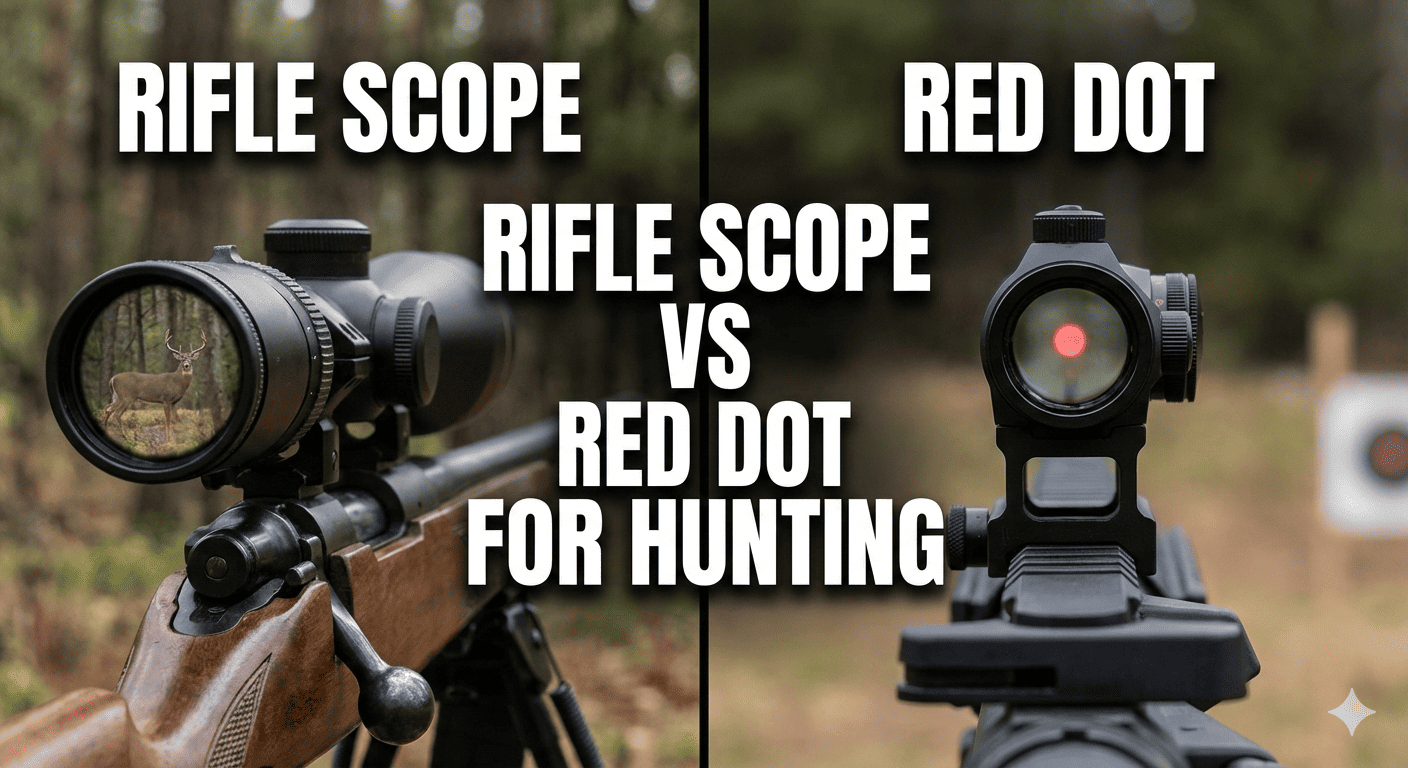
Choosing the right optic can make or break a hunting trip. Two of the most popular sighting systems today are the traditional rifle scope and the modern red dot sight. Both have their strengths, and both are designed for very different hunting scenarios. Understanding how they work, where they excel, and where they fall short will help you pick the best option for your hunting style, terrain, and target species.
Table of Contents
- Understanding the Basics
- Key Differences at a Glance
- Performance in Real Hunting Scenarios
- Accuracy and Shot Placement
- Weight, Balance, and Rifle Handling
- Battery Dependence and Reliability
- Cost Considerations
- Which One Should You Choose?
- The Best of Both Worlds: Low-Power Variable Optics (LPVO)
- Final Verdict
Understanding the Basics
What Is a Rifle Scope?
A rifle scope is a magnified optical device that uses lenses to bring distant targets closer and clearer. It usually features adjustable magnification (for example, 3–9x, 4–12x, or 6–24x), an internal reticle (crosshair), and turrets for adjusting windage and elevation.
Rifle scopes are designed for precision at medium to long ranges. They allow hunters to place accurate shots on small vital zones, even hundreds of meters away.
What Is a Red Dot Sight?
A red dot sight is a non-magnifying (or very low magnification) optic that projects a glowing dot onto a lens. The dot represents the point of impact, allowing fast target acquisition with both eyes open. Unlike scopes, red dots rely on speed and situational awareness rather than magnification and fine precision.
Red dots are extremely popular in close-range and fast-moving hunting situations, such as driven hunts, thick forests, and predator control.
Key Differences at a Glance
| Feature | Rifle Scope | Red Dot Sight |
|---|---|---|
| Magnification | Yes (fixed or variable) | No (usually 1x) |
| Best Range | Medium to long range | Close to medium range |
| Target Acquisition | Slower but precise | Extremely fast |
| Field of View | Narrower at high magnification | Very wide |
| Precision | High | Moderate |
| Weight & Size | Larger and heavier | Compact and lightweight |
| Battery Dependence | Usually none (except illuminated reticles) | Always battery-powered |
Performance in Real Hunting Scenarios
1. Long-Range Hunting (Open Fields, Mountains, Plains)
If you are hunting in open terrain where shots can easily exceed 150–300 meters, a rifle scope is clearly the better choice.
Why rifle scopes excel here:
- Magnification allows you to identify animals clearly at long distances.
- Precise reticles help place shots in the vital zone.
- Adjustable turrets allow compensation for bullet drop and wind drift.
- Better light gathering for dawn and dusk shots (especially with high-quality glass).
A red dot, in contrast, becomes a limitation at long range because:
- The dot covers too much of the target at distance.
- No magnification means poor target identification.
- Precise shot placement becomes difficult.
Winner for long range: Rifle Scope
2. Close-Range Hunting (Dense Forest, Driven Hunts, Bush Hunting)
In thick woods or when animals appear suddenly at short distances, speed is more important than magnification. This is where red dot sights shine.
Why red dots are ideal:
- Both-eyes-open shooting gives full situational awareness.
- Instant target acquisition.
- No need to align front and rear sights or focus through magnification.
- Excellent for moving targets such as wild boar or deer in driven hunts.
Rifle scopes can feel slow in these conditions, especially if set at high magnification. You may struggle to find the animal in the scope quickly.
Winner for close range: Red Dot Sight
3. Low-Light Conditions (Dawn & Dusk)
Low light is a critical factor for hunters, as many animals are most active at sunrise and sunset.
- Rifle scopes with high-quality glass and large objective lenses perform very well in low light, especially when paired with illuminated reticles.
- Red dots are visible in low light, but they do not enhance the target image itself. You can see the dot, but the animal may still appear dark or unclear.
Winner for low light clarity: Rifle Scope
Winner for dot visibility: Red Dot Sight
Accuracy and Shot Placement
Rifle Scope Accuracy
Rifle scopes allow precise aiming at specific anatomical points (heart, lungs, shoulder). At longer distances, this precision is essential for ethical kills and clean harvests.
Red Dot Accuracy
Red dots are accurate within their effective range (typically up to 100–150 meters for hunting). However, the dot size (measured in MOA) can cover several inches of the target at longer distances, reducing precision.
For small vital zones or longer shots: Rifle scope
For fast center-mass shots: Red dot
Weight, Balance, and Rifle Handling
- Rifle scopes are heavier and can affect the balance of lightweight hunting rifles.
- Red dots are compact and maintain a natural, fast-pointing feel.
For long mountain hunts where every gram matters, weight can become an important factor.
Battery Dependence and Reliability
- Traditional rifle scopes work without batteries (unless illuminated).
- Red dots are entirely battery-dependent. While modern batteries last long, failure at the wrong moment is still a risk.
Hunters who prefer absolute mechanical reliability often favor scopes.
Cost Considerations
- Entry-level red dots are usually cheaper than quality rifle scopes.
- High-end red dots and high-end scopes can both be expensive, but for long-range precision, investing in a good scope often provides better value for money.
Which One Should You Choose?
Choose a Rifle Scope If:
- You hunt in open terrain.
- Your typical shooting distance is over 100–150 meters.
- Precision and ethical long-range shots matter most.
- You hunt at dawn or dusk and need good light transmission.
Choose a Red Dot Sight If:
- You hunt in dense forests or thick brush.
- You participate in driven hunts.
- You target fast-moving game.
- You want ultra-fast target acquisition at short range.
The Best of Both Worlds: Low-Power Variable Optics (LPVO)
For hunters who want versatility, a low-power variable scope (1–4x, 1–6x, or 1–8x) can combine advantages of both:
- At 1x, it functions similarly to a red dot.
- At higher magnification, it provides scope-like precision.
- Ideal for mixed terrain and changing hunting conditions.
Final Verdict
In the debate between a rifle scope and a red dot for hunting, there is no one-size-fits-all answer. Each optic is built for a different purpose, and the “best” choice depends entirely on how and where you hunt. Rifle scopes offer magnification, precision, and superior performance at medium to long ranges, making them ideal for open terrain and careful, long-distance shot placement. Red dot sights, on the other hand, excel in speed, simplicity, and close-range effectiveness, which is crucial in dense forests, driven hunts, and fast-moving target situations.
Ultimately, your hunting environment, typical shooting distance, and personal shooting style should guide your decision. If accuracy at range and detailed target identification matter most, a quality rifle scope is the better investment. If quick reaction time and wide field of view are your top priorities, a red dot sight will serve you well. Choosing the right optic ensures not only better performance, but also more ethical, confident, and successful hunts.