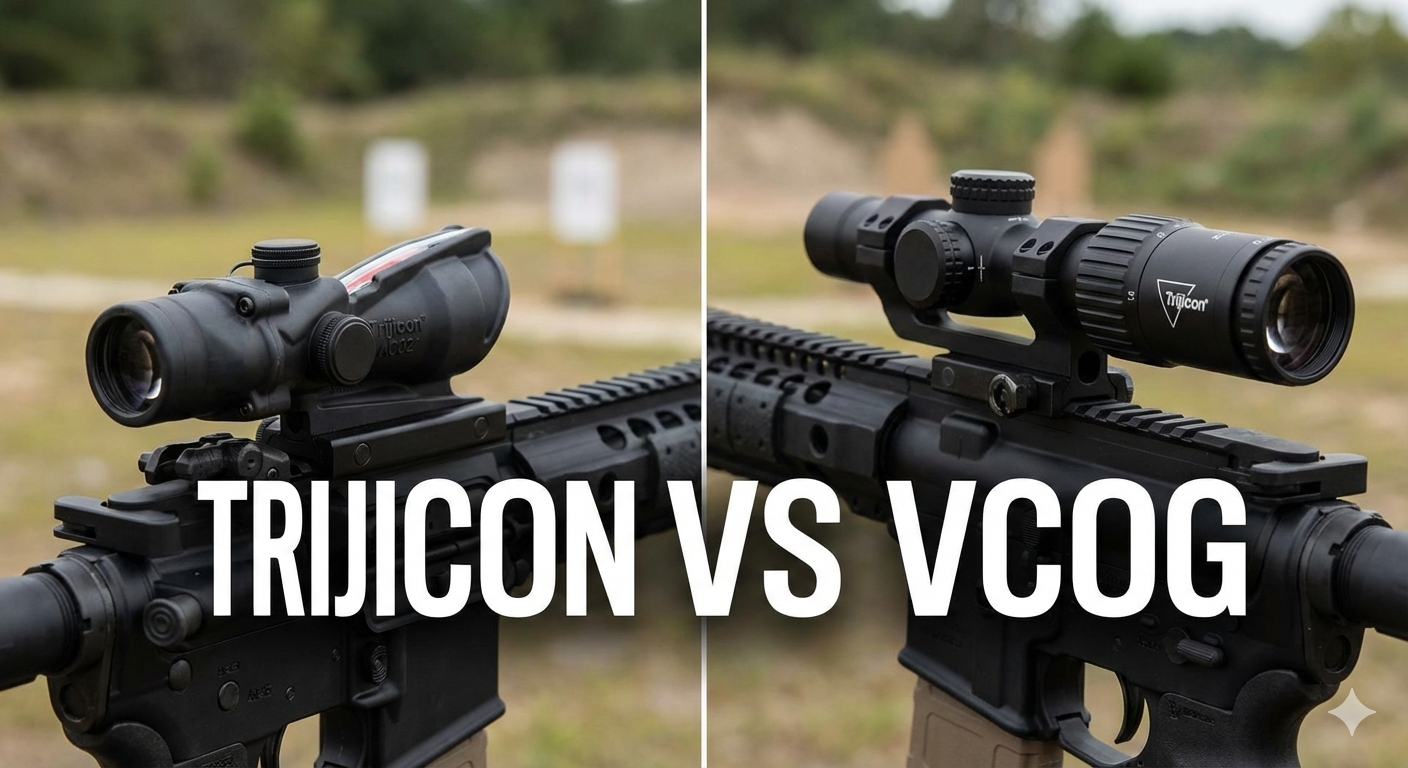
When it comes to combat-proven rifle optics, few brands command the same level of respect as Trijicon. For decades, Trijicon ACOG vs VCOG scopes have been trusted by military units, law enforcement, and professional shooters around the world. Among their most iconic products are the ACOG (Advanced Combat Optical Gunsight) and the VCOG (Variable Combat Optical Gunsight). While both are built for extreme durability and battlefield reliability, they are designed around very different optical philosophies.
This in-depth side-by-side review compares the Trijicon ACOG and VCOG across optical performance, magnification, reticle systems, durability, weight, use cases, and overall value, helping you decide which optic best suits your shooting needs.
Table of Contents
The Trijicon ACOG is a fixed-magnification prism scope originally developed for military use in the late 1980s. It was designed to provide fast target acquisition, crystal-clear glass, and unmatched ruggedness without relying on batteries. Over the years, the ACOG has become legendary for its ability to withstand harsh environments, heavy recoil, and continuous field use while maintaining zero and optical clarity.
One of the defining characteristics of the ACOG is its simplicity. Because it uses a fixed magnification—most commonly 4x, though other variants exist—the internal optical system contains fewer moving parts. This reduces mechanical complexity and increases long-term reliability. The reticle is typically illuminated using a combination of fiber optics for daylight and tritium for low-light conditions, allowing the scope to function without any external power source. This makes the ACOG especially attractive for military and survival applications where battery dependency is a concern.
Optically, the ACOG offers a wide field of view for its magnification level, excellent edge-to-edge sharpness, and high contrast. Its design supports the Bindon Aiming Concept, which allows shooters to keep both eyes open and use the illuminated reticle almost like a red dot at close range, while still benefiting from magnification for mid-range engagements.
The Trijicon VCOG represents a more modern evolution of the combat optic. Instead of fixed magnification, it features a variable zoom system, commonly ranging from 1–6x or 1–8x depending on the model. This allows the shooter to transition seamlessly from close-quarters engagements at true 1x to precision shooting at extended distances with higher magnification.
The VCOG is built with the same durability standards as the ACOG but incorporates advanced features such as a first focal plane reticle, battery-powered illumination, and precision adjustment turrets. The first focal plane design means the reticle subtensions remain accurate across all magnification levels, which is particularly valuable for ranging targets and applying ballistic holds.
While the VCOG is heavier and more complex due to its variable lens system, it is engineered to withstand extreme recoil, shock, and environmental exposure. It is often described as one of the most rugged variable-power scopes on the market, combining the flexibility of a low-power variable optic with the toughness expected from a military-grade sighting system.
Both the ACOG and VCOG deliver excellent optical performance, but they achieve it in slightly different ways. The ACOG’s fixed-power design allows Trijicon to optimize the lens system for one specific magnification. This results in exceptional sharpness, minimal distortion, and a bright image even in challenging lighting conditions. The simplicity of the optical path also contributes to fast eye alignment and consistent performance.
The VCOG, with its variable magnification, must balance optical performance across a range of zoom levels. Despite this added complexity, Trijicon’s high-quality glass and coatings ensure that image clarity remains outstanding throughout the magnification range. At low power, the VCOG provides a wide field of view suitable for close-quarters situations, while at higher magnifications it offers the resolution needed for precise shot placement at distance.
The most fundamental difference between the ACOG and VCOG lies in their magnification systems. The ACOG uses fixed magnification, which means the shooter always views the target at a constant zoom level. This can be an advantage in scenarios where engagement distances are predictable and rapid response is critical. There is no need to adjust magnification, and the shooter can focus entirely on target acquisition and trigger control.
The VCOG, by contrast, offers adjustable magnification, making it far more versatile in dynamic environments. At 1x, it can function similarly to a red dot, allowing fast target transitions and situational awareness. As magnification increases, it becomes suitable for longer-range precision shooting. This adaptability makes the VCOG particularly well-suited for mixed-distance engagements, competition shooting, and tactical roles where a single optic must cover multiple scenarios.
ACOG reticles are typically etched and illuminated using fiber optics and tritium. During the day, ambient light gathered by the fiber optic brightens the reticle automatically. In low light, the tritium provides a constant glow. This system is extremely reliable and requires no batteries, but brightness control is limited and depends on environmental lighting conditions.
VCOG reticles, on the other hand, are usually first focal plane designs with battery-powered LED illumination. This allows precise control over brightness levels and ensures compatibility with night-vision devices. Because the reticle scales with magnification, holdovers and ranging marks remain accurate at any zoom setting, which is a significant advantage for precision shooting and long-range engagements.
Both optics are built to military specifications and are designed to survive extreme abuse. The ACOG’s fixed design contributes to its legendary durability, as there are fewer internal components that can shift or fail. Its housing is forged from high-strength aluminum and sealed against water and dust.
The VCOG, despite its variable zoom system, is equally robust. Its reinforced housing, integrated mount, and shock-resistant construction allow it to handle heavy recoil and harsh environmental conditions. While it contains more moving parts than the ACOG, it is engineered to maintain zero and optical alignment even under severe stress.
The ACOG is generally lighter and more compact than the VCOG, making it well-suited for lightweight rifle setups and extended carry. Its smaller footprint also contributes to better balance on shorter carbines.
The VCOG is heavier due to its larger lens system and zoom mechanism. While this adds some weight to the rifle, many shooters accept this trade-off for the increased capability and flexibility that variable magnification provides.
| Feature | Trijicon ACOG | Trijicon VCOG |
|---|---|---|
| Magnification | Fixed (e.g., 3.5x, 4x, 5.5x) | Variable (1–6x, 1–8x) |
| Reticle Type | Etched, fiber optic & tritium | First focal plane, LED illuminated |
| Power Source | No battery (most models) | Battery powered |
| Weight | Lighter, more compact | Heavier, more robust |
| Best Use | Fast mid-range engagements | Close to long-range versatility |
| Durability | Extremely rugged | Extremely rugged with modern design |
The choice between the ACOG and VCOG depends largely on your intended use. If your priority is simplicity, speed, and absolute reliability with minimal maintenance, the ACOG remains one of the best fixed-power combat optics ever made. It is ideal for users who operate primarily at medium ranges and value battery-free operation.
If you need a single optic capable of handling close-quarters engagements, mid-range shooting, and longer-range precision, the VCOG offers unmatched versatility. Its variable magnification, advanced reticle system, and modern features make it a strong choice for tactical professionals, competition shooters, and enthusiasts who demand adaptability.
Is the ACOG better for military use than the VCOG?
Both are suitable for military use, but the ACOG is often preferred for its simplicity and battery-free operation, while the VCOG is chosen for missions requiring variable engagement distances.
Does the VCOG replace the ACOG?
Not entirely. The VCOG offers more versatility, but the ACOG remains relevant for roles where fixed magnification and extreme reliability are priorities.
Which optic is better for civilian shooters?
Civilian shooters who participate in competitions or varied-distance shooting may benefit more from the VCOG. Those who prefer a lighter, simpler setup may find the ACOG more suitable.
The Trijicon ACOG and VCOG both represent the pinnacle of combat-grade optic design, each excelling in its own domain. The ACOG stands as a symbol of proven reliability and speed, while the VCOG embodies modern versatility and precision. Choosing between them is not a matter of which is superior overall, but which one aligns more closely with your shooting environment, mission requirements, and personal preferences.
Selecting the best scope magnification for shooting at 300 yards is a decision that directly…
Traveling with a firearm whether for hunting, competitive shooting, professional training, or lawful personal protection…
Preparing for a successful day at the shooting range involves much more than simply bringing…
Selecting the right tactical scope for hunting is one of the most important decisions a…
Hunting has always been deeply connected to nature, patience, and self-reliance. For generations, success in…
Choosing the right rifle scope is one of the most important decisions a shooter or…
This website uses cookies.
