Understanding Ballistic Drop for Hunters: A Complete Guide to Accurate Long-Range Shooting
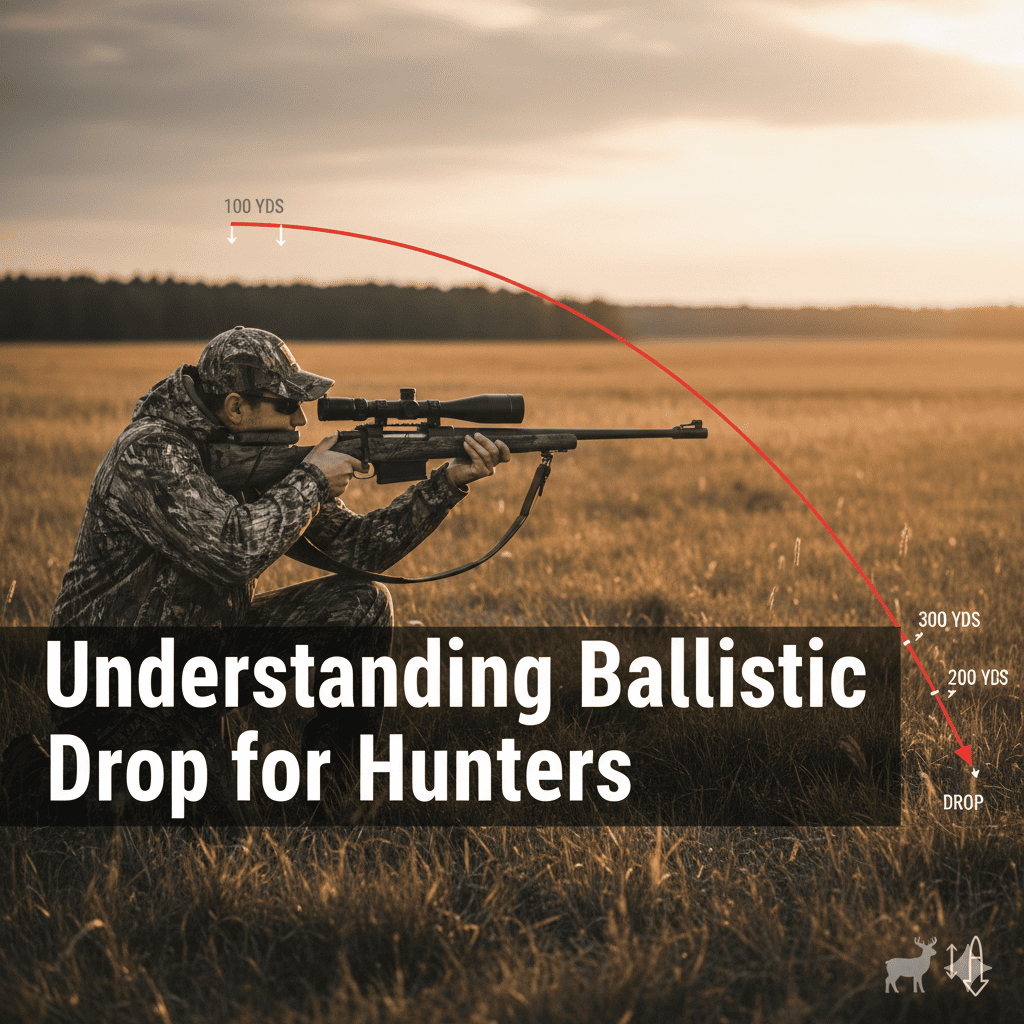
Accurate shot placement is the foundation of ethical and successful hunting. Whether you are pursuing deer in open plains, elk in the mountains, or varmints at extended distances, understanding ballistic drop is essential. Many missed or poorly placed shots are not caused by poor marksmanship, but by a misunderstanding of how gravity and distance affect a bullet’s flight path. This guide explains ballistic drop in detail and shows hunters how to compensate for it in real-world conditions.
Table of Contents
- What Is Ballistic Drop?
- Why Ballistic Drop Matters in Hunting
- The Physics Behind Bullet Trajectory
- Key Factors That Affect Ballistic Drop
- Understanding Holdover and Scope Adjustments
- Ballistic Charts and Range Cards
- Practical Example of Ballistic Drop
- The Role of Rangefinders
- Ethical Considerations
- Training to Master Ballistic Drop
- Conclusion
What Is Ballistic Drop?
Ballistic drop, often called bullet drop, is the vertical distance a projectile falls due to gravity as it travels toward the target. The moment a bullet leaves the muzzle, gravity begins pulling it downward. Even though the bullet is traveling at extremely high speed, it is still subject to the same gravitational force as any other object.
The rifle barrel is angled slightly upward relative to the line of sight when a scope is zeroed. This allows the bullet’s curved trajectory to intersect the line of sight at a chosen distance, such as 100 or 200 yards. Beyond this zero distance, the bullet continues to fall, and the drop becomes increasingly pronounced as range increases.
Why Ballistic Drop Matters in Hunting
In hunting, precise shot placement is critical for clean, humane kills. A few inches of vertical error can mean the difference between a heart-lung hit and a wounded animal that escapes. As distance increases, bullet drop becomes more significant, and guessing holdover without understanding the physics can lead to missed shots or poor impacts.
Long-range hunting, in particular, demands a solid grasp of trajectory and drop. Even at moderate distances like 300 yards, many popular hunting calibers can experience a drop of 7 to 12 inches depending on velocity and bullet weight.
The Physics Behind Bullet Trajectory
Bullet trajectory is a curved path influenced by several forces. Gravity is the primary cause of vertical drop, but air resistance, also known as drag, slows the bullet and increases the time it spends in flight, allowing gravity more time to act on it. The longer the bullet is in the air, the more it drops.
The trajectory is not a straight line. It begins slightly upward, reaches a peak, crosses the line of sight at the zero distance, and then continues downward. The shape of this curve is affected by velocity, ballistic coefficient, and environmental conditions.
Key Factors That Affect Ballistic Drop
Muzzle Velocity
Higher muzzle velocity means the bullet reaches the target faster, reducing time under gravity’s influence and therefore reducing drop. A fast .243 Winchester will generally have less drop at 400 yards than a slower .45-70 Government.
Ballistic Coefficient (BC)
The ballistic coefficient describes how efficiently a bullet moves through the air. A high-BC bullet experiences less drag, retains velocity better, and drops less over long distances. Modern hunting bullets with sleek profiles are designed specifically to improve BC.
Bullet Weight
Heavier bullets often have higher BC but may start with lower velocity. The interaction between weight and shape determines how much drop occurs. A heavy, high-BC bullet can sometimes drop less at long range than a lighter, low-BC bullet.
Zero Distance
Your rifle’s zero has a major impact on how much holdover is required. A 100-yard zero will require more compensation at long range than a 200-yard zero. Many hunters prefer a 200-yard zero because it minimizes holdover within typical hunting distances.
Altitude and Air Density
Air is thinner at higher altitudes, reducing drag and flattening trajectory. A rifle zeroed at sea level will shoot slightly higher in the mountains. Temperature, humidity, and barometric pressure all play roles in altering ballistic drop.
Understanding Holdover and Scope Adjustments
Hunters compensate for ballistic drop in two main ways: holding over or dialing elevation.
Holdover involves aiming above the target by a known amount, often using reticle markings. This method is fast and effective for moderate ranges.
Dialing elevation means adjusting the scope’s turret to raise the point of impact. This is more precise for long-range shots, provided the shooter has accurate ballistic data and a reliable scope.
Both methods rely on knowing how much drop occurs at specific distances, which is typically measured in inches, minutes of angle (MOA), or milliradians (MIL).
Ballistic Charts and Range Cards
A ballistic chart shows the expected drop of a specific bullet at various distances. These charts are generated using velocity, BC, zero distance, and environmental conditions. Many hunters create a personalized range card and attach it to their rifle or stock for quick reference in the field.
Modern ballistic calculators and smartphone apps make it easy to generate accurate data, but it is still essential to confirm it by shooting at known distances.
Practical Example of Ballistic Drop
Consider a .308 Winchester zeroed at 200 yards. At 300 yards, the drop may be around 7 inches. At 400 yards, it may reach 18 to 20 inches. At 500 yards, the bullet could drop more than 40 inches. Without proper compensation, a hunter aiming dead center at 500 yards would completely miss the vital zone.
This illustrates how rapidly drop increases with distance and why estimating range accurately is just as important as understanding trajectory.
The Role of Rangefinders
A laser rangefinder is one of the most valuable tools for modern hunters. Since ballistic drop is directly tied to distance, knowing the exact range allows for precise holdover or turret adjustment. Guessing range, especially in open terrain, can easily result in several inches of vertical error.
Ethical Considerations
Understanding ballistic drop is not only about improving accuracy but also about ethical responsibility. Hunters must ensure they can place shots cleanly and consistently within the vital zone of the animal. Taking long-range shots without a solid understanding of trajectory and drop increases the risk of wounding.
Practicing at extended distances, learning your rifle’s behavior, and confirming ballistic data are essential steps for responsible hunting.
Training to Master Ballistic Drop
Regular range practice at multiple distances builds confidence and familiarity with your rifle’s trajectory. Shooting steel targets or paper at 300, 400, and 500 yards allows you to see real-world drop and compare it with predicted values. This experience is invaluable when conditions in the field are less than perfect.
Conclusion
Ballistic drop is a fundamental concept every serious hunter must understand. From the moment a bullet leaves the muzzle, gravity shapes its path, and the farther it travels, the more pronounced the effect becomes. By learning how velocity, bullet design, environmental factors, and zero distance influence trajectory, hunters can make accurate adjustments and place ethical, effective shots.
Mastering ballistic drop is not just about numbers and charts; it is about building the knowledge and confidence needed to make every shot count when it matters most.