Long-range shooting demands a high level of precision, consistency, and confidence in your equipment. As distances increase, even minor miscalculations in elevation, wind, or ranging can lead to complete misses. This is why choosing the right optic is critical. Among experienced shooters, competitors, and professionals, the first focal plane scope for long range shooting has become the preferred choice. Its design directly supports accuracy, speed, and reliability at extended distances.
This guide explains what a first focal plane scope is, how it works, and why it is widely considered the best option for long-range and precision shooting.
Table of Contents
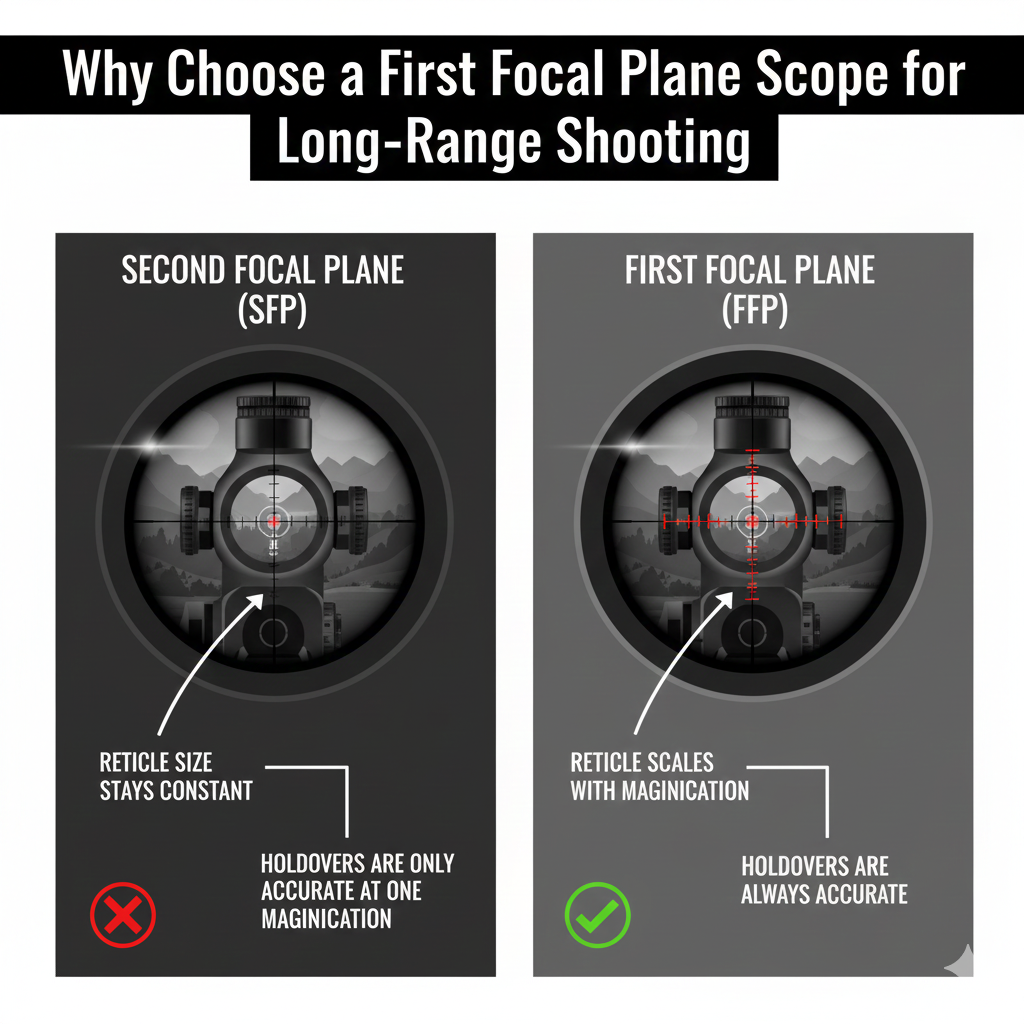
A first focal plane (FFP) scope is designed so that the reticle is placed in front of the magnification system. As magnification increases or decreases, the reticle scales proportionally with the image. This means the reticle appears smaller at low magnification and larger at high magnification, while its measurement values remain constant.
This design ensures that reticle subtensions—whether measured in MIL or MOA—are always accurate, regardless of zoom level. In contrast, a second focal plane scope keeps the reticle the same size at all magnifications, making reticle measurements accurate only at a single preset magnification.
Long-range shooters rely heavily on their reticle for elevation holdovers, wind corrections, and ranging. At distances beyond a few hundred yards, bullet drop becomes significant, and dialing turrets for every shot is not always practical or efficient.
With a first focal plane scope, reticle measurements remain true at all magnifications. This eliminates guesswork and prevents costly errors caused by using the wrong zoom level. For long-range shooting, where precision is everything, this consistency is a major advantage.
Accuracy at long distance is not only about the rifle and ammunition; it is also about how reliably the shooter can apply corrections. A first focal plane scope allows shooters to hold accurately for elevation and wind without worrying about magnification settings.
Whether shooting at 10x or 20x, one MIL in the reticle always equals one MIL on the target. This makes FFP scopes ideal for shooters who frequently adjust magnification based on target size, distance, or field of view while maintaining absolute confidence in their holds.
Speed plays a critical role in practical long-range shooting, especially in competitions like PRS and NRL. Targets may appear at different distances within the same stage, requiring rapid adjustments.
First focal plane scopes allow shooters to engage targets quickly because reticle accuracy is never affected by zoom changes. Shooters can adjust magnification for clarity or field of view and immediately apply correct holds without rechecking settings. This efficiency reduces mental workload and improves hit probability under time pressure.
Ranging is a key skill in long-range shooting, particularly when engaging unknown-distance targets. Many shooters estimate distance by measuring a target’s known size using reticle markings.
Because a first focal plane reticle is always dimensionally accurate, ranging can be performed at any magnification. This flexibility is especially valuable in hunting or tactical scenarios where time is limited and adjusting magnification to a specific setting may not be possible.
Modern long-range rifle scopes often feature advanced reticles, such as Christmas tree or grid-style designs. These reticles allow shooters to hold for both elevation and wind simultaneously, enabling fast follow-up shots and efficient corrections.
These complex reticles are designed to function correctly only in first focal plane scopes. Since the reticle scales with magnification, all hold points remain accurate at every zoom level. This makes FFP scopes the preferred choice for shooters who rely heavily on reticle-based shooting techniques.
Wind is the most challenging variable in long-range shooting. Conditions can change rapidly between the shooter and the target, requiring constant adjustment.
First focal plane scopes simplify wind corrections by allowing precise wind holds at any magnification. Shooters can observe impacts, measure the miss using the reticle, and correct immediately without dialing turrets. This faster correction process improves consistency and increases hit rates at long distances.
When comparing first focal plane vs second focal plane scopes for long range shooting, the differences become clear. FFP scopes offer consistent reticle accuracy at all magnifications, faster engagement, and superior ranging capabilities. SFP scopes, while often less expensive and easier to see at low magnification, limit reticle accuracy to a single zoom setting.
For shooters who regularly shoot beyond mid-range distances, use holdovers, or compete in precision disciplines, the advantages of a first focal plane scope far outweigh its drawbacks.
Military snipers, law enforcement precision shooters, and elite competitors overwhelmingly choose first focal plane optics. These professionals operate in environments where mistakes are costly and equipment reliability is essential.
The consistent performance of FFP scopes reduces cognitive load, allowing shooters to focus on fundamentals rather than equipment limitations. This professional-level trust further confirms why FFP scopes dominate the long-range shooting world.
Although first focal plane scopes excel at long range, they are not perfect for every shooter. At low magnification, the reticle can appear thinner, which may be less desirable for close-range or low-light use. Additionally, FFP scopes typically cost more due to their complex design.
For shooters who primarily operate under 300 yards, rarely change magnification, or prefer a bold, constant reticle, a second focal plane scope may be sufficient. However, these limitations become less relevant as shooting distance increases.
A first focal plane scope is best suited for long-range target shooters, precision rifle competitors, tactical users, and hunters who regularly engage targets at extended distances. Anyone who relies on reticle holdovers, ranging, and fast corrections will benefit significantly from an FFP optic.
For serious long-range shooting, a first focal plane scope is more than just a premium feature—it is a performance advantage. Its ability to maintain reticle accuracy at all magnifications, support advanced reticle designs, and improve speed and consistency makes it the gold standard for precision shooting.
While first focal plane scopes require a higher investment and a short learning curve, they deliver unmatched reliability and confidence at distance. For shooters who demand accuracy where it matters most, choosing a first focal plane scope for long range shooting is a smart and proven decision.
Selecting the best scope magnification for shooting at 300 yards is a decision that directly…
Traveling with a firearm whether for hunting, competitive shooting, professional training, or lawful personal protection…
Preparing for a successful day at the shooting range involves much more than simply bringing…
Selecting the right tactical scope for hunting is one of the most important decisions a…
Hunting has always been deeply connected to nature, patience, and self-reliance. For generations, success in…
Choosing the right rifle scope is one of the most important decisions a shooter or…
This website uses cookies.
